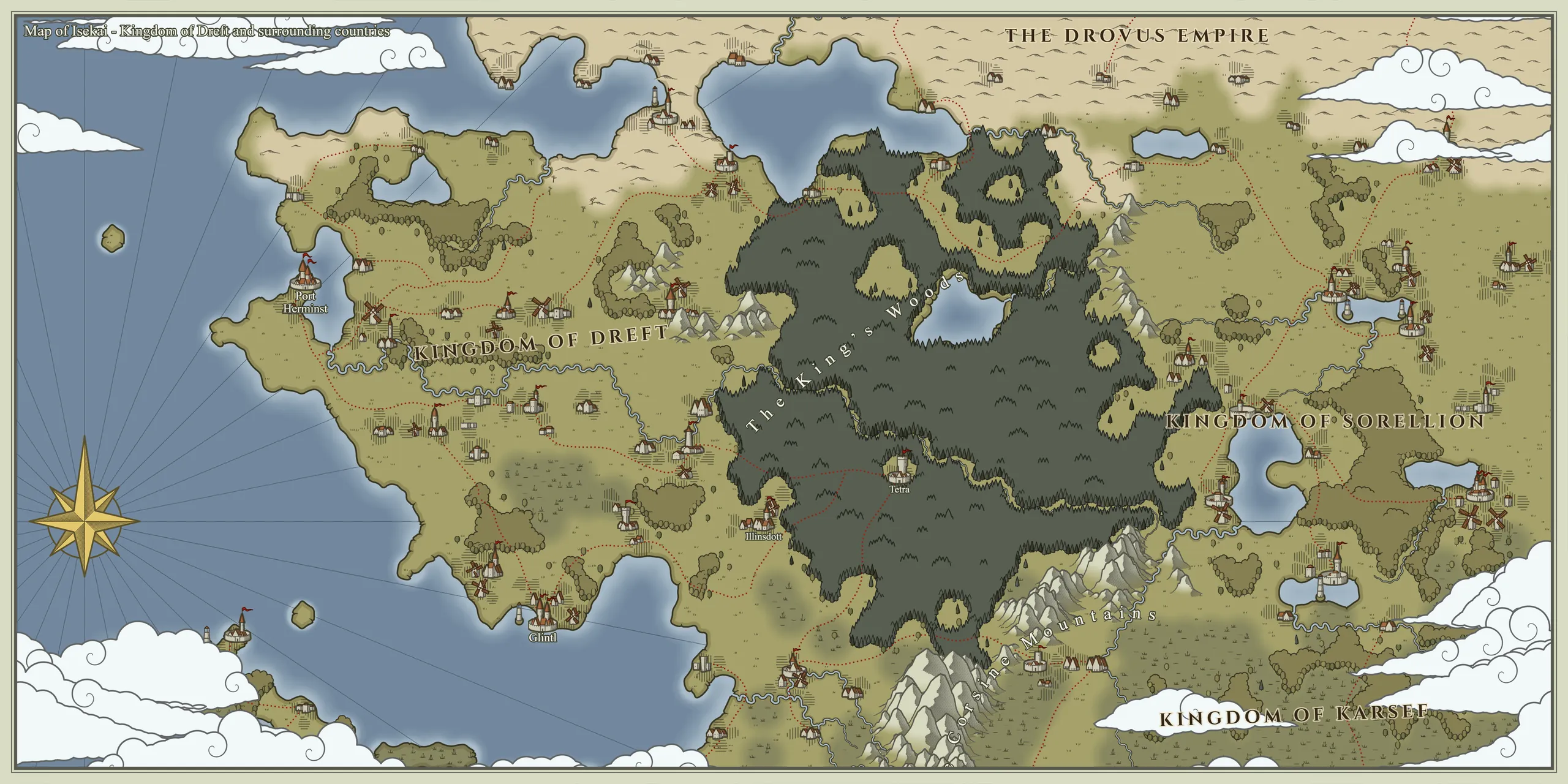
Formally the culmination of a series of binding UN resolutions meant to distance the governing authority of the UN from the regional politics of Earth, Tetra was the brainchild of the Stellar Democratic Union’s then-president, Ichiha Ushida.
An architect in his early years, Ushida was always prone to the bouts of fantastical utopianism that made him a successful politician. Originally proposed as a more modest administration craft intended to act at the center of a Unionist political caravan fleet, the project gained Ushida’s full political weight when, before the delegates of the United Nations (and blindsiding his own administration), he announced his dream of a floating island-city, one that would put the politics of the UN quite literally above the day-to-day squabbles of earthly empires and reach out to humanity’s future among the stars.
The construction of Tetra was a nearly decade-long endeavor. It was first laid down in 2163, with reactor ignition in 2169 and its official opening in 2172. Funded primarily by the SDU during Ushida’s tenure, the Ark was labeled a white elephant as its costs ballooned. Despite early criticisms, though, and in large part because of Ushida’s direct hand in the planning stages, humanity’s first purpose-built Ark is a triumph of architectural and stellar engineering.
Tetra was Ushida’s utopian political project every bit as much as it was an architectural one. The permanent citizen-residents of Tetra practice a form of government called “Liquid Democracy.” As in a direct democracy, every citizen of Tetra has a single vote in all matters of state and government, but they can delegate their vote to another individual, who can, in turn, pass on both their own vote and the ones entrusted to them. In this way, rather than voting for representatives, individuals place their trust in a chain of individuals. Citizens with a larger vote share are, in theory, more politically aware and invested than those who choose to temporarily hand their vote to another. For nearly 60 years, through this system, the politics of Tetra have been stable, relatively incorruptible, and famously boring.
While Tetra was initially conceived as a political and administrative capital, the first switch-gate catastrophe in 2175 brought a new mission to the Ark. The all-too-foreseeable accident that erased New York City created an urgent need for safer planar exploration and a much heavier hand in its regulation. The Protocols of Planar Exploration and Exploitation, never ratified by the American Empire, were expanded, and the Bureau of Planar Management and Enforcement was founded to oversee and enforce them.
The Bureau’s presence on Tetra, as well as Tetra’s axiomatically stable nature as a slow-orbiting body, made it the natural home for planar investment. The majority of Earth-bound planar exploration industries quickly relocated to the Ark, where licensure, inspection, and regulatory approval are made much cheaper and easier by proximity.
The oldest and most storied exploration ventures call Tetra home, and while unregulated planar exploitation is on the rise, the Bureau has eyes and ears everywhere in the Settled Systems.